Universal Data Acquisition

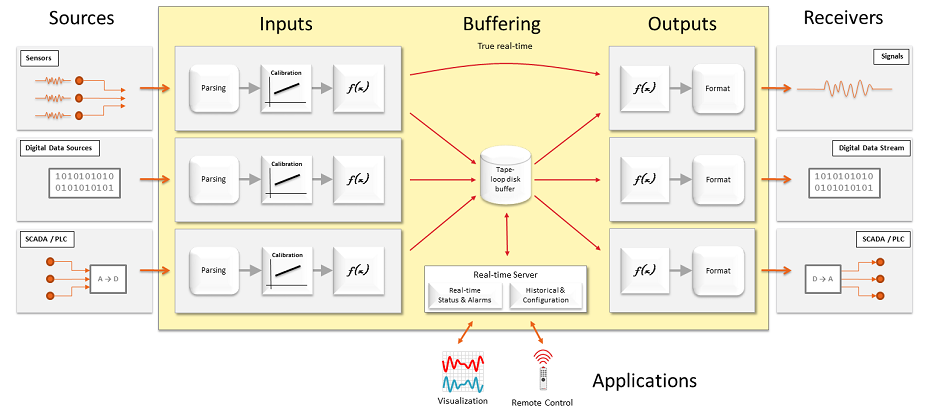
PetroDAS supports all sensor types used in the oil and gas industry, including rig floor sensors (hookload, pressure, RPM, torque, block position, etc.), and pit sensors (level, rpm, flow in/out density & temperature, etc.). PetroDAS can also aggregate data in digital formats, such as the WITS data from other contractors at the rig, or the instrumentation PLC pre-installed at the rig.
System Architecture
PetroDAS is a multi-threaded application, where each component acts independently. This designs allows for high data rate measurements and transmission, even when interruptions occur in the inputs or outputs.
Inputs and Outputs
PetroDAS supports simultaneous input from multiple sources, and output to multiple destinations. Examples include the aggregation of data from multiple contractors at the rig, and delivery to one or more real-time systems.
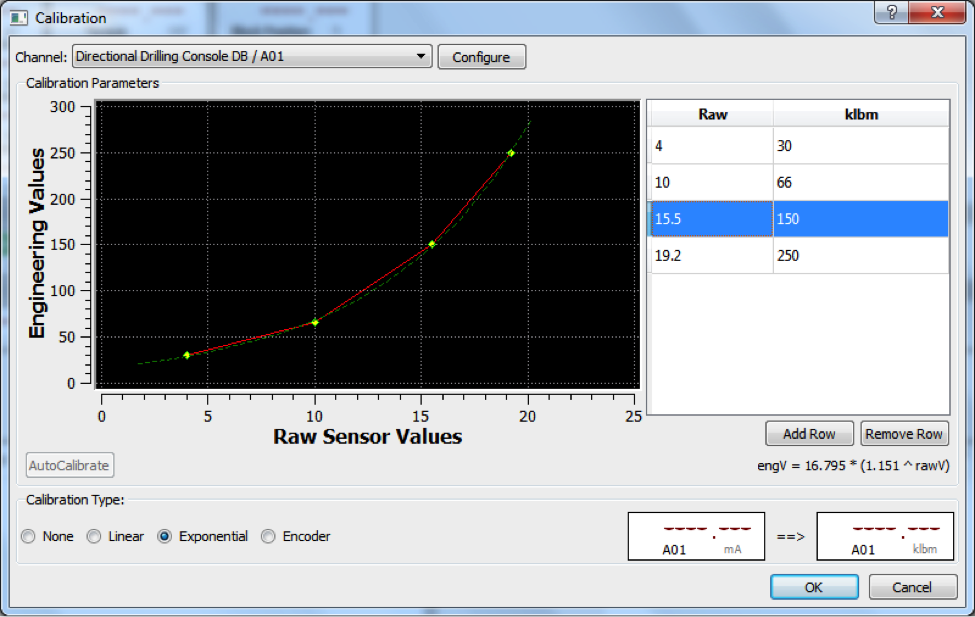
In addition to pure digital inputs, PetroDAS handles analog sensors as part of the data stream. The built-in calibration functionality allows the user to easily set the calibration points for each sensor. Once an input source has been demultiplexed, any of the channels can be sent to any of the destination outputs.
PetroDAS supports many industrial automations as well as oil & gas specific formats and protocols. For the complete list, please see PetroDAS Transport and Protocol Support page.
Sensor Calibration
PetroDAS includes a sensor calibration facility that allows you to calibrate the sensor response to engineering values as needed.
The calibration types include Linear, Exponential, and Drawworks sensor response profiles. The calibration can be performed prior to the operation start, or during the operation. The re-calibrated values are output immediately after the operator completes the calibration routine.
Calculations
The PetroDAS System provides an interface for scripting calculations. It allows rapid and immediate data processing to the input and output channels. PetroDAS uses Python as the programming language for scripting.

Buffering
Buffering in PetroDAS is implemented with a high speed binary database, optimized for fast data acquisition. The buffer acts as a tape loop, ensuring that the disk space in the unit is not completely used up.
Real-Time and Web-Service API
PetroDAS implements a fast and efficient real-time data transmission and web-service API for configurations, visualization, and synchronization with other systems. The PetroDAS Remote application takes advantage of the Web-Service API for all system configuration, using the web-service API defined in the PetroDAS WSDL, and the following data schemes: